Dynamic vs Static QR Codes — What's the Difference?
Understanding the key differences between dynamic and static QR codes. Learn when to use each type and their benefits for your business or personal use.
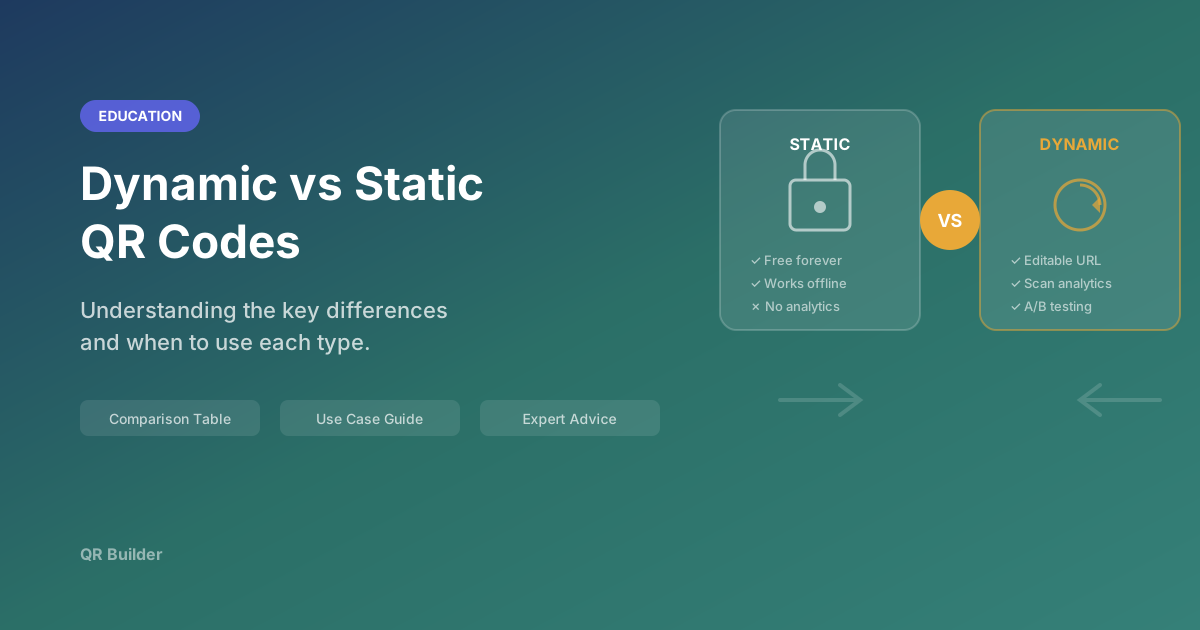
When creating QR codes, one of the most important decisions is choosing between static and dynamic QR codes. Each has distinct advantages depending on your use case, and understanding the difference can save you time, money, and frustration. This guide covers everything you need to know about both types, with practical advice on when to use each one.
Understanding How QR Codes Store Data
To understand the difference between static and dynamic QR codes, you first need to understand how QR codes work at a fundamental level.
A QR code is a visual representation of data. The pattern of dark and light modules (the small squares that make up the code) encodes a string of characters. When a scanner reads the code, it decodes the pattern back into that string — a URL, a phone number, a block of text, or any other data.
The key insight is this: the more data you encode, the more complex the QR code pattern becomes. A QR code encoding a 10-character string will have a simpler, easier-to-scan pattern than one encoding a 200-character URL. This fundamental relationship between data length and pattern complexity is what drives the difference between static and dynamic QR codes.
What is a Static QR Code?
A static QR code encodes information directly into the QR pattern itself. The actual content — whether it is a full URL, a paragraph of text, WiFi credentials, or contact information — is embedded directly in the modules of the code.
Once a static QR code is generated, its content is permanently fixed. The data lives entirely within the visual pattern. There is no server, no redirect, and no middleman. The QR code IS the data.
Advantages of Static QR Codes
Permanence: Static QR codes never expire, never go offline, and never depend on a third-party service remaining operational. As long as the linked content (like a website) exists, the QR code works. The code itself has no expiration date.
No Ongoing Costs: Since there is no redirect service involved, there are no subscription fees or hosting costs associated with the QR code itself. You generate it once and use it forever.
Offline Functionality: For non-URL types like text, WiFi, and vCard, static QR codes work completely offline. The scanner does not need an internet connection to read the data — it is all encoded in the pattern. This makes them ideal for environments with limited connectivity.
Privacy: No data passes through a third-party server when a static QR code is scanned. The content goes directly from the code to the scanner's device. There is nothing to track and no middleman that could potentially log scan data.
Speed: Scanning a static QR code is marginally faster because there is no redirect step. The scanner reads the data and acts on it immediately — no DNS lookup, no HTTP redirect, no waiting for a server response.
Limitations of Static QR Codes
Cannot Be Edited: Once created, the content is fixed. If you need to change the destination URL, fix a typo, or update contact information, you must create a new QR code and replace every printed instance of the old one.
No Analytics: Static QR codes provide no scan tracking. You cannot see how many times the code was scanned, where scans occurred, what devices were used, or when scans happened. For personal use this is rarely an issue, but for marketing campaigns it is a significant limitation.
Larger Patterns for Long Data: Since all data is encoded directly, long URLs or large amounts of text result in more complex QR patterns with more modules. More complex patterns are harder to scan at small sizes and require higher print quality.
What is a Dynamic QR Code?
A dynamic QR code uses a short redirect URL instead of encoding the actual destination directly. When you create a dynamic QR code, the generator stores your intended destination on a server and creates a short URL (like qrb.io/a1b2c3) that redirects to it.
The QR code itself only encodes this short redirect URL. When someone scans the code, their device:
- Reads the short URL from the QR pattern
- Sends a request to the redirect server
- The server logs the scan (analytics) and sends back the actual destination
- The user's device opens the final destination
This intermediary step is what enables all the dynamic features.
Advantages of Dynamic QR Codes
Editable Destination: You can change where the QR code sends people at any time, without altering the QR code itself. Printed a thousand flyers with a QR code? If the destination URL changes, just update the redirect — all existing codes automatically point to the new location.
Full Analytics: Every scan passes through the redirect server, which can log:
- Total number of scans
- Unique scans (by IP address)
- Geographic location of scans
- Device type and operating system
- Time and date of each scan
- Referrer source (how the QR code was accessed)
Shorter, Simpler QR Pattern: Because the encoded URL is always short (the redirect URL), dynamic QR codes have simpler patterns regardless of how long the final destination URL is. Simpler patterns are easier to scan, especially at small sizes or on lower-quality prints.
Deactivation: You can disable a dynamic QR code at any time without physically removing it. This is useful for time-limited promotions, expired offers, or codes that were deployed in error.
A/B Testing: Some dynamic QR code platforms allow you to split traffic between multiple destinations to test which landing page performs better — a powerful tool for marketing optimization.
Limitations of Dynamic QR Codes
Dependency on Redirect Service: If the redirect server goes down or the service shuts down, all your QR codes stop working. This is a single point of failure that does not exist with static codes.
Ongoing Costs: Most dynamic QR code services charge a subscription fee, especially for higher scan volumes or advanced analytics features. Free tiers typically have limitations on the number of codes or scans.
Privacy Considerations: Every scan passes through a server that can log user data. Depending on the service provider's privacy practices, this may raise concerns for privacy-conscious users or in regulated industries.
Internet Required: The redirect step requires an internet connection at scan time. If the user is offline, the redirect cannot complete and the QR code will not work — even if the final destination is a local resource.
Latency: There is a small but measurable delay introduced by the redirect step — typically 50-200 milliseconds. While usually imperceptible, this can add up in scenarios with slow network connections.
Detailed Comparison
| Feature | Static QR Code | Dynamic QR Code |
|---|---|---|
| Content Editable | No — fixed at creation | Yes — change anytime |
| Scan Analytics | No tracking available | Full analytics suite |
| Expiration | Never expires | Depends on service |
| QR Pattern Complexity | Higher (encodes full data) | Lower (encodes short URL) |
| Internet Required | No (for non-URL types) | Yes (always) |
| Third-Party Dependency | None | Redirect service required |
| Ongoing Cost | Free forever | Usually subscription-based |
| Speed | Instant decode | Adds redirect latency |
| Privacy | Maximum (no server) | Data passes through server |
| Best For | Permanent, simple content | Campaigns, editable content |
When to Use Static QR Codes
Static QR codes are the better choice when:
- WiFi credentials — Your network password rarely changes, and guests need offline-capable scanning
- Business cards with vCard — Contact information that is unlikely to change soon
- Fixed locations — Address or coordinates that are permanent
- Text instructions — Safety information, equipment labels, or reference numbers
- Long-term signage — Permanent signs where the destination will not change
- Privacy-sensitive contexts — Healthcare, legal, or financial applications where data should not pass through third-party servers
- Budget is zero — You need a completely free solution with no ongoing costs
When to Use Dynamic QR Codes
Dynamic QR codes are the better choice when:
- Marketing campaigns — You need to track scan rates, measure ROI, and optimize performance
- Content that changes — Restaurant menus, event schedules, promotional offers that update regularly
- Time-limited promotions — Campaigns that need to be deactivated after a specific date
- A/B testing — You want to test different landing pages to find the highest-converting option
- Large-scale printing — When reprinting is expensive and you need the flexibility to change destinations
- Retail and e-commerce — Product packaging where the linked content may need seasonal updates
Making the Right Choice
For most personal and small-scale uses, static QR codes are the simplest and most reliable choice. They are free, permanent, and have no dependencies. If you are making a WiFi QR code for your home, a vCard for your business card, or a URL link for a flyer, static is the way to go.
For business applications where you need analytics, the ability to update destinations, or campaign-level tracking, dynamic QR codes provide essential capabilities that justify their cost. The key is to choose a reliable service provider that you trust will remain operational for the lifetime of your printed materials.
QR Builder currently generates static QR codes with full customization and the highest error correction level. This means every code you create is production-ready, works offline for applicable types, and will function reliably for as long as the linked content exists.
Ready to Create Your QR Code?
Start generating free, customizable QR codes in seconds. No sign-up required.
Create QR Code Free